By Fr. Tony Melton & Christ The King Anglican Church in Marietta, Georgia
Christ the King Anglican began when Fr. Tony Melton and his family moved to Atlanta in July 2019 to plant a new church—parachute-style. After gathering an initial group, he planned to begin Sunday services in March 2020, which ended up being just four days after the COVID lockdown began. The launch team group was spread throughout northwest Atlanta, and even before starting services, it was decided to plant a daughter church in a nearby area as soon as possible. In other words, we “planted pregnant.”
This commitment to church planting naturally led us to ministry residencies. If we wanted to plant churches, we needed to train up and send out church planters—and that’s exactly what we did. Here is a timeline of our journey into residencies:
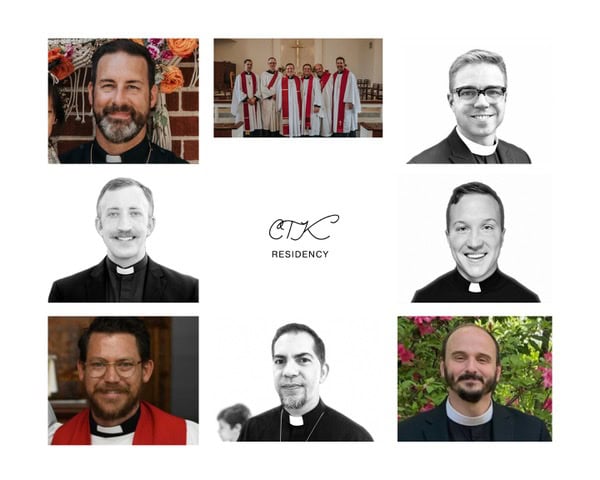
- In January 2022, we welcomed our first planting resident, Fr. Jesse Barkalow, who was later sent out to plant in Colorado Springs, CO.
- In June 2022, we brought on our second resident, (now Fr.) Spencer Amaral, who was sent out to plant a daughter church in Canton, GA, just north of us.
- In October 2022, we hired our third resident, (now Fr.) Tyler Holley, who became our Associate Rector.
- In July 2023, we brought on our fourth resident, Fr. Yudel Perez, who was commissioned to plant a Hispanic congregation within CTK.
- In December 2024, we purchased a house for residents right next to the church.
- In January 2025, we welcomed our fifth resident, Fr. Alex Marlowe, who was sent to plant a church in Johnson City, TN.
- In January 2025, we started an extension seminary campus of Cranmer Theological House for our seminary interns.
- In February 2025, we received a grant from Made to Flourish to accelerate our residency program.
- In July 2025, we brought on our sixth resident, Fr. Hunter Van Wagenen, who will be sent to plant a daughter church near us in 2027.
In summary, we’ve had six residents in our first five years as a church plant. Including our own parish, four churches have already been successfully planted, and a fifth is underway. A key part of our story is that every full-time hire has served as a resident, and nearly all of those residents have been sent out to plant new churches. We intend to keep this up; raising up tomorrow’s planting rectors has become our vision and passion.
Advantages of Residencies
 Residents shape parish culture. People genuinely love the residents. They root for them! A resident can shift a parish’s mindset away from consumerism. Parishioners start asking how they can help and bless the resident.
Residents are also great staff. They are eager to learn, full of energy, and hungry for opportunity to do real ministry work. They are teachable. They don’t come in with opinions, theology, or habits set in concrete. Their ministry approach can be deeply shaped by the residency.
Furthermore, residents are willing to church plant. Residents have an openness to do hard things…like a residency. Thus, they are often open for tougher things, like a church plant. Even more importantly, residents create better rectors. Having a protege presses rectors to codify and share their wisdom. This makes them better leaders and physicians of the soul.
Finally, it is the right thing to do. Jesus was all about residencies. He had 3, 12, 70…when ministry gets tough, there is comfort in knowing that you are doing the work that Jesus did. Also, there is greater joy in seeing what God does in their ministry than in your own.
Challenges of Residencies
But residencies take work. Rectors must invest time in their residents. Some things are caught through osmosis. Other things need explanation or exhortation. Also, residencies aren’t long-term. You invest a lot, send them off to serve the Church elsewhere, and then start over again.
Lessons We’ve Learned
Residencies aren’t overly complex. Just give to a resident what God has given you: the books, experiences, skills, and wisdom that you have are invaluable to your resident. Residencies also make sense practically. At first, residencies didn’t make sense on paper. We chose them initially out of conviction. But now we see that the positives of residencies far outweigh “traditional” hiring practices. Your next hire should be a resident. You can afford a residency. Residents can fundraise, and there are grants out there. Made to Flourish is an incredible resource. Even if you don’t get their Residency Accelerator Grant, they have a lot of know-how on how to do residencies well.
Your diocese might help get one started in your parish. Also, if you hire a resident that is skilled in outreach, the position might pay for itself before long. The Lord provides when we trust Him, so have a non-scarcity mindset. Seek to give away what you have and watch how God comes through.